

Poppy Coburn has become one of the more recognisable young voices in British opinion journalism, known for her work shaping the comment pages of The Daily Telegraph and for a sharp, debate-ready presence on X (formerly Twitter). For readers trying to understand who she is, what she has written, and how she built her career, this guide pulls together the verified facts about her education, her rise through British media, and the political commentary that has defined her public profile — without repeating the unconfirmed personal details (exact birthdates, family claims, “net worth” figures) that circulate on lower-quality profile sites but aren’t actually backed by a credible source.
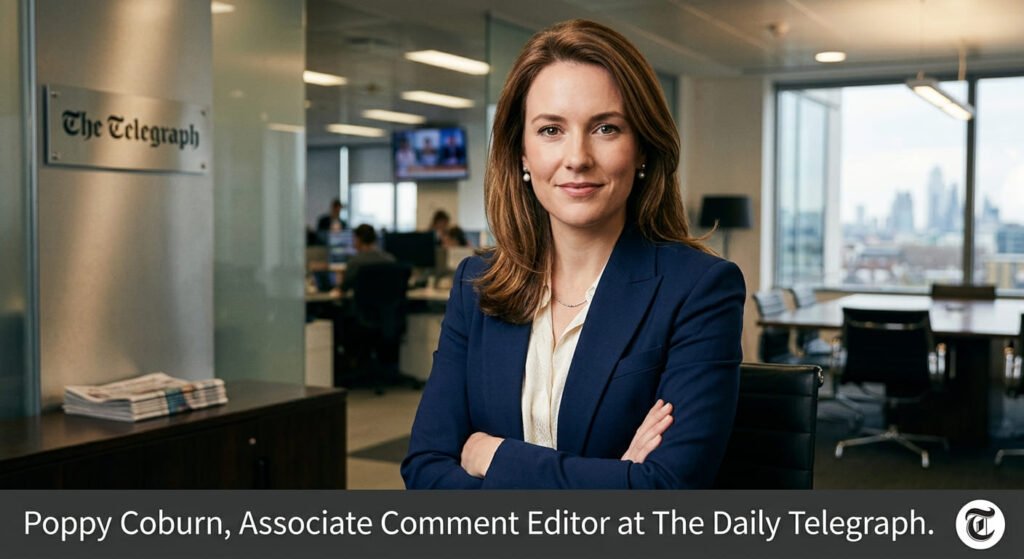
Who Is Poppy Coburn?
Poppy Coburn is a British journalist and editor who works on the comment desk at The Daily Telegraph in London, where she both writes her own opinion columns and helps commission and edit the work of other contributors. Her byline title has appeared in slightly different forms across platforms — the Telegraph’s own author page describes her as an Associate Comment Editor, while her LinkedIn profile has used Assistant Comment Editor, and some event listings have referred to her as an acting Deputy Comment Editor. These variations most likely reflect a title that has evolved as her responsibilities grew, rather than any inconsistency in the underlying role.
Her writing centres on British politics, immigration and border policy, welfare reform, class and social mobility, free speech, universities, human rights law, and the political attitudes of younger generations. She is also known for editing and commissioning US-focused commentary for the paper, giving her columns and desk work a transatlantic angle that has become one of her trademarks.
Early Life and Education
School Years in Essex
Coburn grew up in the UK and attended Colchester Royal Grammar School in Essex, a selective state grammar school with a strong academic reputation. It was during these school years that she developed the early interest in politics and public affairs that would eventually shape her career.
University of Cambridge
She went on to study History and Politics at the University of Cambridge, earning a BA (Hons). Her academic work reportedly included a particular focus on the political philosopher Thomas Hobbes, whose ideas about authority, order, and the state have visibly influenced the framing of some of her later political writing. While at Cambridge, she was also involved in student politics and debate, which gave her early experience in the kind of public argument that now defines her journalism.
Career Journey: From Freelancer to Comment Editor
Starting Out at GB News
After graduating in 2021, Coburn’s first move into professional media was as a primetime producer at GB News, the British news channel known for its politically engaged, often right-leaning programming. This role gave her hands-on experience with broadcast journalism and live political coverage before she shifted her focus toward opinion writing.
Freelance Opinion Writing
Around the same period, Coburn began contributing opinion pieces as a freelancer to a number of UK outlets, including The Critic, UnHerd, The Express, and PoliticsHome, alongside early freelance contributions to The Telegraph itself, which reportedly date back to April 2021. This freelance period allowed her to build a byline and a following before stepping into a formal editorial role.
Joining The Daily Telegraph
In August 2023, Coburn joined The Daily Telegraph full-time, taking up her role on the comment desk. Since then, she has combined editing duties — commissioning, shaping, and refining opinion pieces from other writers — with publishing her own columns on British and American politics. Her work has also extended into audio and video formats: she has appeared alongside fellow Telegraph opinion writer Michael Deacon on “The Weekend T,” a lighter, discussion-style spin-off from the paper’s Daily T podcast, where the pair discuss offbeat and topical news stories.
The Claremont Institute Fellowship
Coburn has also been named as a Publius Fellow at the Claremont Institute, a US-based conservative think tank. Fellowships of this kind typically involve a structured programme of reading, writing, and seminars focused on political philosophy and public policy, and this connection underlines the transatlantic dimension of her work — she writes not just about British politics, but regularly engages with American conservative and nationalist political thought as well.
Journalistic Style and Political Views
Coburn is generally associated with a conservative, nationalist-leaning perspective within British commentary, and she has been open about identifying as a “meritocracy fan” in her public bio. Her columns and social media commentary frequently push back against what she characterises as progressive orthodoxy on issues like immigration, university culture, and identity politics, while also being willing to criticise the mainstream Conservative Party when she feels it has failed to deliver on the causes she cares about.
What distinguishes her from many opinion writers of her generation is the way she frames current debates through a historical and philosophical lens — a habit that traces back to her Cambridge studies — rather than relying purely on day-to-day news reaction. She has commented critically on concepts like “disinformation” as a framing device in political debate, and has covered subjects ranging from party conference politics to welfare policy fights within the governing party.
Media Appearances
Beyond her written work, Coburn has become a recurring guest across British broadcast and podcast platforms discussing UK and US politics. She appeared on the podcast Maiden Mother Matriarch, hosted by journalist Louise Perry, for an episode titled “The Zoomer Right,” which examined how the political attitudes of Generation Z conservatives differ from both millennial activism and traditional establishment conservatism. She has also appeared on TalkTV discussing current affairs.
Online Presence
Coburn maintains an active and widely followed presence on X, where she posts under the handle @kafkaswife — a literary reference to Franz Kafka that nods to her interest in literature and to the “Kafkaesque” quality she often ascribes to modern bureaucracy and institutions. Her account has become a hub for real-time commentary on British politics, often generating significant engagement around major political moments, including party conference season and high-profile parliamentary votes.
She is considerably less active professionally on Instagram, where her account (@poppy_coburn) is used in a much more personal capacity and carries far less political content than her X presence.
Where to Read Her Work
Coburn’s columns and commissioned pieces appear regularly in The Daily Telegraph‘s comment section, accessible through the paper’s website with a digital or print subscription. Readers looking to follow her writing directly can search her byline on the Telegraph’s site to find her published archive, or follow her on X for shorter-form commentary and links to her latest pieces.
Frequently Asked Questions
What is Poppy Coburn’s job title at The Telegraph? Her role has been described as both Associate Comment Editor and Assistant Comment Editor across different official sources, reflecting the evolution of her position since she joined the paper full-time in August 2023.
Is Poppy Coburn related to BBC presenter Jo Coburn? There is no credible evidence connecting the two. The shared surname and overlapping careers in political media appear to be the source of the confusion, but no reliable record supports a family relationship.
Where did Poppy Coburn go to university? She studied History and Politics at the University of Cambridge, graduating with a BA (Hons).
What topics does Poppy Coburn usually write about? Her work centres on British politics, immigration, welfare policy, class, free speech, higher education, human rights law, and generational political change, along with US political commentary for a UK audience.
Conclusion
Poppy Coburn’s career reflects a fairly rapid rise from grammar-school student to a genuine editorial voice at one of Britain’s major national newspapers, built on a foundation of Cambridge-honed political theory, early broadcast experience at GB News, and a freelance writing period that established her byline before she joined The Telegraph full-time in 2023. Her combination of philosophical grounding and direct, debate-ready commentary — both in print and on X — has made her one of the more distinctive young voices in contemporary British conservative journalism, and one whose columns and commissioned pieces are likely to remain part of the UK’s political conversation for some time to come.